Your crusher is working hard. The conveyors are moving. The plant sounds busy.
But the finished-product pile is not growing the way it should.
Before approving a larger crusher, ask a different question: How much of the material moving through the plant becomes saleable product, and what does each finished ton cost?
Crushing plant efficiency depends on how the entire circuit works together. A larger machine can help when crushing capacity is the actual constraint. If the problem is elsewhere, more crusher capacity may simply move the bottleneck.
Why Cost per Saleable Ton Deserves Attention
Equipment capacity matters, but nameplate tons per hour does not describe the full economics of an operating plant.
For a practical comparison, track:
Operating cost per saleable ton = defined operating costs ÷ saleable tons produced during the same period.
Include the same cost categories each time, such as power or fuel, labor, wear parts, and maintenance. For investment decisions, assess capital and financing costs separately or include them consistently in a clearly defined total-cost model.
Consider this simplified illustration:
- Plant A incurs $2,400 in defined operating costs and produces 800 saleable tons: $3.00 per ton.
- Plant B incurs $2,600 and produces 1,000 saleable tons: $2.60 per ton.
These are hypothetical figures, not Apache performance results. They show why a higher daily operating bill can still accompany a lower unit cost.
The important denominator is finished, specification-compliant product. Material passing a belt scale repeatedly is not additional finished production.
1. Start With the Feed
A crushing circuit designed around one material can behave differently when the feed changes.
Review particle-size distribution, moisture, hardness, abrasiveness, and the amount of fines entering each stage. Look for changes between working areas or production runs.
Also ask whether material arrives consistently. Surges and interruptions can make it harder to keep connected equipment operating within its intended range.
Useful questions include:
- Has the feed changed since the circuit was selected?
- Is material distributed appropriately across the screen?
- Are the feeder and upstream stages supplying a stable flow?
- Are observations being compared under similar material conditions?
Use the equipment manufacturer's operating requirements. Feed level and preparation should match the specific crusher and application.
2. Check What the Screen Sends Back
In a closed crushing circuit, a screen separates material into size fractions. Material requiring further reduction returns to the crusher.
That return stream is normal. The question is whether it contains material that should already have passed to the next stage.
Blinded or pegged openings, unsuitable media, or an overloaded deck can impair separation. Already-small particles may remain with the oversize stream and make another trip through the circuit.
That extra material occupies capacity in the crusher, screen, and return conveyor. Review separation performance before assuming the crusher needs more horsepower.
A worn or damaged screen can create the opposite problem: oversized material reaching the product stream. More tons are not useful if the product misses specification.
3. Review Wear Parts as Process Components
Liners and screening media influence production, not just maintenance spending.
A crushing chamber's geometry changes as liners wear. Its suitability also depends on the material and the required product. Settings, chamber selection, screen apertures, and operating limits should be evaluated together.
The lowest purchase price or longest service life does not automatically produce the lowest cost per finished ton. Compare wear cost alongside product yield, throughput, and consistency.
Apache's OEM and aftermarket parts offerings include replacement and manganese wear parts. Confirm compatibility and application requirements before ordering.
4. Measure the Circuit Before Changing It
Build a baseline using representative production periods:
- Fresh feed and finished-product tonnage.
- Return-stream tonnage, where reliably measured.
- Product gradation and rejected material.
- Power or fuel consumption.
- Unplanned downtime and its recorded causes.
- Wear-part consumption and maintenance costs.
Reliable belt scales, samples, and operating records help distinguish a repeatable problem from a temporary change in feed.
Inspect transfer points and conveying capacity as well. A restriction downstream can limit the benefit of an upstream upgrade.
5. Choose the Upgrade That Addresses the Constraint
The next step could be a feed arrangement change, different screening media, a suitable wear-part configuration, or additional capacity at a particular stage.
Sometimes a larger crusher is the right answer. Sometimes the screen or material handling system needs attention first.
Compare options against a specific production target and verify results under comparable conditions. Keep product quality and equipment operating limits in the evaluation.
Any physical inspection, cleaning, or maintenance must follow the manufacturer's instructions and the site's applicable energy-isolation and safety procedures.
Build Around the Product You Need to Sell
The useful goal is consistent production of the right material at a supportable cost.
Apache Iron Works offers crushers, screens, feeders, material handling equipment, and engineered systems for aggregate and mining operations.
Before your next equipment purchase, bring Apache your feed information, target gradation, current production figures, and the constraints you are seeing. That gives the equipment discussion a practical starting point.
Discuss your equipment needs with Apache Iron Works or call 307-772-4563.
Capacity, wear life, energy use, and operating costs depend on material characteristics, equipment configuration, maintenance, and site conditions. No specific production increase or savings is guaranteed.
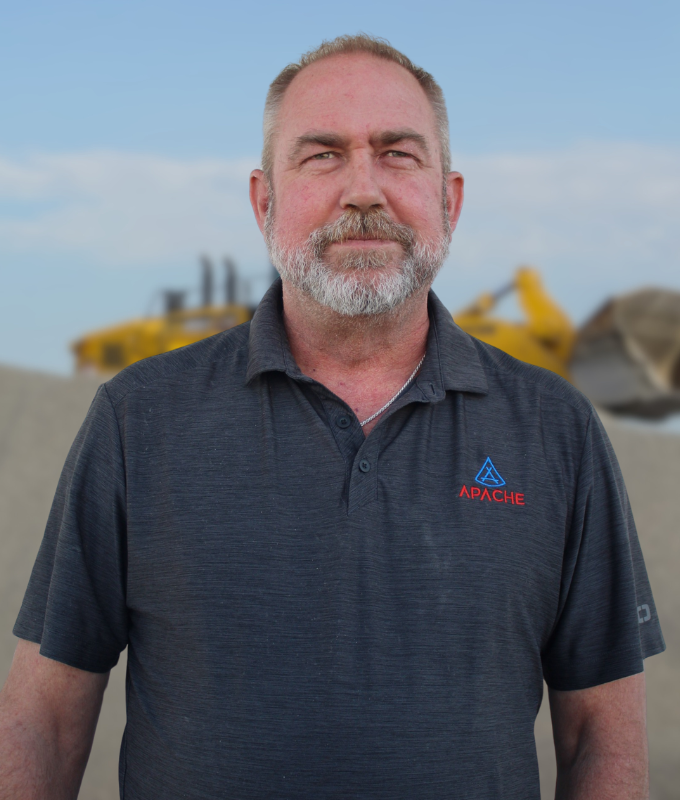
About the Author
Nathan Myers
Co-Founder & Managing Director
Nathan Myers is Co-Founder and Managing Director of Apache Iron Works, headquartered in Cheyenne, Wyoming. With 30 years in the mining and aggregate equipment industry, he has helped design and deliver more than 180 mining projects across 7 states and 7 countries.